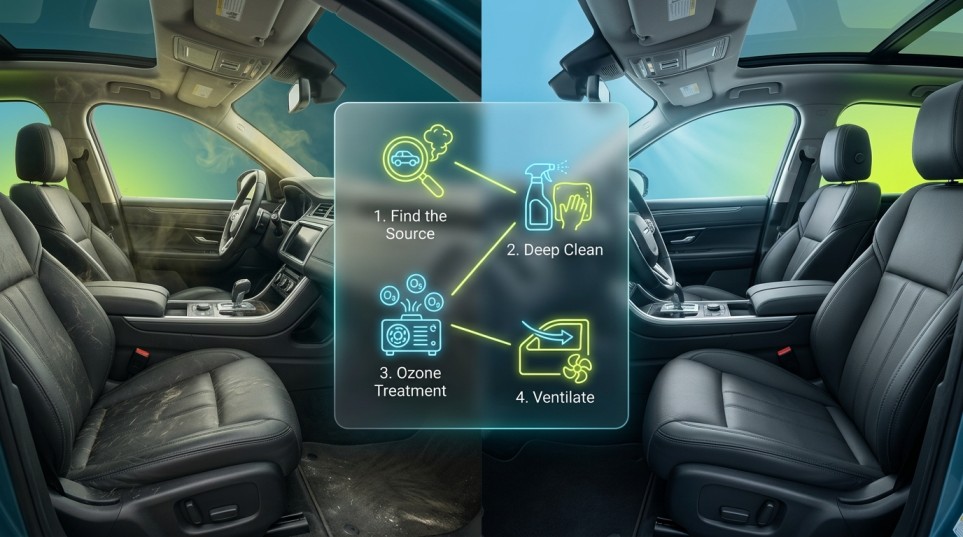
Car Odor & Ozone Removal Guide explains how professional car odor removal works, when ozone treatment is appropriate, what ozone can and cannot remove, and why some vehicle odors return after treatment. From smoke and pet odors to food spills, mildew, and mystery smells, the right solution depends on finding and treating the source first.
Professional car odor removal works by finding and removing the material causing the smell, then treating whatever residue is left behind in fabric, foam, and vents. Ozone treatment is one step in that process, not the whole process. It can break down odour compounds in an empty vehicle, but it cannot remove a wet floor pan, a spoiled spill, or a contaminated cabin filter. Results depend on what the inspection finds.
Key Takeaways
- Ozone is a finishing step, not a fix. If the source material is still in the vehicle, the smell usually returns within days or weeks, no matter how long the generator ran.
- Ozone is not safe to breathe. Health Canada advises against using ozone generators in homes, and no federal agency has approved them for use in occupied spaces. Treatment happens with nobody inside, followed by proper ventilation.
- The odour type changes the method. Milk, urine and vomit usually need enzyme treatment and extraction. Smoke leaves a surface film that has to be cleaned off before any treatment helps.
- Calgary winters create the conditions. Snow melting into carpet, road salt, condensation and months of recirculated cabin air are behind most local odour complaints.
- Cost depends on severity, not just vehicle size. Ozone odour removal is a $50 add-on at Steam Clean Auto Detailing. Most stubborn odours need interior detailing first, which starts at $179.
Most people do not book odour removal because their car smells slightly stale. They book because something specific happened. A litre of milk went sideways in the back seat. A previous owner smoked in the vehicle for six years. Or the smell appeared on its own when the heat came on in October, and nobody can find where it is coming from.
Those are different problems with different fixes. This guide explains how professional odour removal works, what ozone can and cannot do, how to tell whether your vehicle needs a deep clean or a full odour treatment, what it costs in Calgary, and what to ask before you hand over your keys.
Car Odor & Ozone Removal Guide: How Professional Odor Removal Works
Car odour removal is a service. Ozone treatment is one tool used inside that service. Confusing the two is the most common reason people spend money and stay disappointed.
How Professional Car Odor Removal Works
A professional odour job follows a sequence: find the source, remove or treat the source, then use ozone on what is left. Inspection comes first, because you cannot treat a source you have not found. Then comes physical removal, which might mean full vacuuming, extraction of contaminated carpet, cleaning under the seats, or treating mats separately. Only after that does oxidative treatment make sense.
Think of it the way you would think about a smell in your kitchen. Air freshener does nothing while the source is still under the fridge. The same logic applies in a vehicle, except a vehicle also has foam, carpet padding, and a duct system holding residue.
How Ozone Neutralizes Odor Molecules
Ozone is oxygen in a three-atom form, written as O₃. An ozone generator splits oxygen molecules so they recombine into O₃, which fills the sealed cabin, reacts with what it contacts, and then breaks back down into ordinary oxygen over a period of hours. That breakdown is why treatment is followed by ventilation rather than by any neutralizing chemical.
Because ozone is a strong oxidizer, it alters the structure of certain odour compounds so they no longer produce the same smell. That is a chemical change rather than a masking effect, and it is the real advantage of the method. The limits are just as important. The United States Environmental Protection Agency notes that scientific evidence supporting ozone as an odour remover is limited, that ozone concentrations would need to greatly exceed health standards to remove most indoor air contaminants, and that ozone reacting with other chemicals can produce compounds that are themselves irritating or corrosive. Ozone reacts with what it can reach. It does not remove contamination buried in carpet padding or seat foam.
What Types of Car Odors Can Be Removed?
Smoke, pet, food, mildew, and general stale-cabin odours all respond to professional treatment in most cases, though to different degrees. Smells tied to a mechanical fault do not. A sweet syrup smell from a coolant leak, a burning smell, a fuel smell, or exhaust inside the cabin needs a mechanic, not a detailer.
Odours tied to water intrusion sit in the middle. If a plugged sunroof drain or failing door membrane keeps soaking the carpet, cleaning gives temporary improvement,t and the smell comes back. The leak has to be fixed first.
Car Odor Problems in Calgary
Winter Moisture, Snow, and Road Salt
For roughly five months of the year, most drivers here run with the windows closed and the climate system on recirculate. That traps humidity from breathing, wet clothing, ng and melting snow inside a sealed cabin. Warm, damp and undisturbed is exactly what bacteria and mould need to establish in carpet backing and seat foam.
Every winter trip also carries snow into the footwells on boots. It melts, soaks through the mat and sits in the padding underneath, along with road salt, which holds moisture rather than letting it dry out. That is why a footwell can feel dry on the surface and still be damp two centimetres down, and why a quick vacuum at the gas station does almost nothing for a winter odour problem.
Freeze-Thaw Conditions and Seasonal Patterns
Chinooks swing temperatures dramatically in a single day. A vehicle that sits at minus twenty overnight and warms to plus five by afternoon goes through repeated condensation cycles, leaving moisture on cold interior surfaces including the metal floor pan under the carpet. Foggy windows that will not clear and a musty smell at startup are two signs of the same underlying problem.
The odour builds gradually through January and February, so owners stop noticing it in their own vehicle. Spring is when most odour calls come in, because warmer cabin temperatures accelerate the bacterial activity that has been building all winter. Fall brings the HVAC complaints, when the heat runs for the first time in months and pushes whatever has collected in the ducts into the cabin.
Common Car Odors and How They’re Removed
Cigarette, Cannabis, and Vape Smoke
Smoke odour is a residue problem before it is an air problem. Tobacco and cannabis smoke deposit a film of tar and oils on every hard surface in the cabin, including the inside of the glass, the headliner, and the plastic around the vents, and that film keeps releasing odour for years.
Effective treatment means cleaning surfaces first: glass, hard trim, door jambs and vents. The headliner needs a careful low-moisture approach, because it is bonded with adhesive that can fail if saturated. Ozone afterwards handles what is left in the air and in porous material, and it is genuinely useful here. Long-term smoke exposure is one of the few situations where a single treatment is often not enough, and an honest detailer will say so before taking your money.
Pet and Animal Odors
Pet odour usually comes from three things at once: hair worked into the fibres, oils and dander from the coat, and sometimes urine. Removing hair does not remove the oils, and removing the oils does not remove urine salts.
Hair extraction comes first, using tools that pull hair out of the weave rather than skimming the surface, followed by upholstery cleaning to lift the oils. Urine becomes an enzyme job, described below. Reducing visible hair and dander is a cleaning outcome, not an allergy outcome, and we do not make allergen claims about pet-related detailing.
Food, Milk, and Beverage Spills
Milk and dairy are the worst of this group, because the proteins and fats soak into carpet padding and then decompose. A spill that looked minor at the time can produce a sour smell for months. Coffee with cream behaves the same way, and juice and pop leave sugar residue that feeds bacteria.
Treatment means flushing the area and extracting the liquid rather than blotting the top. If the spill reached the padding, the padding has to be treated too. A surface clean over a soaked pad will smell again once the vehicle warms up.
Vomit, Urine, and Other Biological Odors
These need enzyme treatment. Urine, vomit, and similar contamination leave compounds that ordinary detergent does not break down, and urine in particular leaves crystallized salts that reactivate whenever humidity rises. That is why a cleaned seat can smell fine in December and terrible in July.
Enzyme products need dwell time, often hours, with the treated area kept damp throughout. This is a large part of why odour work takes longer than a standard interior detail. For heavy biological contamination, be direct when you book. Interior detailing is cleaning, not biohazard remediation, and those jobs need to be scoped honestly on both sides.
Mold, Mildew, and Moisture
Musty smells almost always mean water. The common local causes are a leaking sunroof drain, a failed door vapour barrier, a window seal, a plugged HVAC drain, or months of snow melting into the carpet.
The cleaning part is straightforward. Finding the water is the part that matters. We do not describe interior detailing as mould remediation, and we do not claim that cleaning eliminates all mould or spores from a vehicle. If visible growth is present or the carpet is saturated across a large area, say so when booking, because that is beyond a standard interior detail. If the moisture source is not fixed, growth returns.
HVAC and Cabin Air Filter Odors
This is the classic “my car smells, and I cannot find where” case. Your climate system pulls air across an evaporator core that runs cold and stays wet, and dust and organic debris collect on that wet surface as a biofilm. Turn the fan on,n and the air carries the smell into the cabin.
The tell is timing. If the smell is strongest in the first thirty seconds after the fan or air conditioning comes on and then fades, the HVAC system is the likely source rather than the carpet. Treatment involves cleaning accessible vent surfaces, treating the intake area, and replacing the cabin filter. Full evaporator access requires dash disassembly, which is mechanical work rather than detailing.
Used-Car and Mystery Odors
If you bought the vehicle used and it came with a smell you cannot place, assume something was cleaned superficially before sale. Dealer prep often includes a strong fragrance that masks the underlying odour for a few weeks and then wears off.
Inspection focuses on the places a quick pre-sale clean skips: under the seats and seat rails, the rear footwells, the spare tire well, behind the seat backs,s and the cabin filter housing. The actual cause is frequently something small and physical that was simply never found.
Where Car Odors Hide and Why They Return
Carpets, Floor Mats, and Seat Foam
Vehicle carpet is a fibre layer over a foam pad, laid on a metal floor pan. Liquid passes through the top layer quickly and collects in the pad, which dries slowly and gets almost no airflow. Seat foam behaves the same way and is harder to extract because it is thick and enclosed by upholstery. Cloth seats absorb directly; leather and vinyl resist at the surface but let liquid run through seams to the foam underneath, which is why a leather seat can look clean and still smell.
Seats also have heating elements, occupancy sensors, and airbag components underneath in most modern vehicles, which limits how much moisture can responsibly be used. Rubber all-weather mats help enormously in Calgary because they contain meltwater instead of letting it through.
Headliners and Upholstery
Headliners hold smoke odour particularly well, since warm air and smoke collect at the top of the cabin. They are also the most fragile interior surface, because the fabric is bonded to a backing board with adhesive that heavy moisture or scrubbing can loosen. We cannot restore a headliner that is already sagging or delaminating, and detailing is not a repair for that.
HVAC Vents and Air Ducts
Ducts are the one area you cannot reach with a towel. They run behind the dash through paths never designed to be cleaned. This is where circulated treatment earns its place: running the fan during ozone treatment pulls the gas through the same route the air travels.
Trunk and Cargo Areas
Cargo areas collect what people forget, from groceries that rolled under the false floor to wet camping and hockey gear. The spare tire well is a particular problem here, because water gets in through worn seals or trunk drains and then sits in a covered metal basin. Any inspection worth paying for lifts the cargo floor and checks it.
Why Air Fresheners Only Mask Odors
An air freshener adds fragrance. It removes nothing, and your nose simply registers the stronger of the two smells. The practical problem is that fragrance fades faster than the underlying odour, so the vehicle smells worse over time as the mask wears off. People respond by adding more, and vehicles arrive for treatment with five hanging fresheners and a smell that is now a mixture of everything.
When Does Your Car Need Professional Odor Treatment?
When Regular Interior Cleaning Is Enough
If the smell is general staleness, mild and recent, with no history of a spill or leak, a thorough interior clean usually resolves it. Vacuuming under the seats, cleaning mats, wiping hard surfaces, replacing an old cabin air filter, and airing the vehicle out handles a surprising number of complaints. For a vehicle that has never had a deep clean, our interior auto detailing service covers that work without any specialized treatment.
Signs an Odor Has Penetrated Deep Into the Interior
- The smell returns within days of a thorough cleaning.
- It gets stronger in warm weather or when the vehicle sits closed in the sun.
- It is concentrated in one area, such as a single footwell or the rear bench.
- Carpet feels cool or damp when you press firmly into it, especially under the mats.
- The vehicle has a known history of a spill, pet accident, leak, or years of smoking.
- The smell surges when the fan starts, then fades.
Any two of these together generally mean a standard clean will not be enough on its own.
When Ozone Treatment Is Appropriate
Ozone makes sense once the source has been removed or treated and a residual smell remains in fabric, foam, headliner,r or the ventilation system. It suits smoke odour, lingering pet smell after hair and oils are cleaned, and stale-cabin odour in older vehicles.
It is not appropriate as a first step on a vehicle with an active leak, standing moisture, an unextracted spill,l or visible mould growth. In those cases, it is money spent on a symptom.
The Professional Car Odor Removal Process
Inspection and Source Identification
The job starts with a walk-through of the vehicle: checking footwells by hand for dampness, lifting mats, looking under seats and seat rails, opening the cargo floor and spare well, and running the climate system on different settings to see whether the smell changes. The history matters just as much. What happened, when, what has already been tried, and whether the vehicle was bought used usually narrows the source faster than any tool.
Deep Cleaning, Enzyme Treatment, and Extraction
Physical removal comes next and is the least glamorous, most important part: full vacuuming including under and between seats, mats cleaned separately, hard surfaces and door pockets cleaned, and hair extraction where pets are involved.
Where organic contamination is present, an enzyme product is applied and given time to work, with dilution and dwell time following the manufacturer’s instructions rather than a general rule. Steam then lifts soil from fabric, and hot water extraction pulls the loosened contamination and moisture back out. The extraction half matters more than people realize, because moisture left in carpet recreates the exact damp conditions that caused the odour. Steam is not appropriate everywhere either, and headliners, screens, some adhesives, and certain specialty upholstery need a different approach.
HVAC and Vent Treatment
Vent surfaces are cleaned where they can be reached, the intake area is treated, and the cabin air filter is inspected. On many vehicles,s the filter sits behind the glove box and takes a few minutes to access.
Ozone Treatment, Ventilation, and Final Check
Once cleaning is complete and the interior is dry, treatment runs in the empty vehicle with the climate system set to circulate so the gas reaches the ducts. Our ozone odor removal treatment is listed as a one-hour add-on at $50, and severe cases may need a longer cycle or a repeat visit, which we discuss before starting rather than after.
The vehicle is then aired out thoroughly, and the result is checked once residual ozone has dissipated. A vehicle assessed while it still smells of ozone tells you nothing useful about whether the original odour is gone.
How Ozone Treatment Removes Stubborn Car Odors
What Ozone Can and Cannot Reach
Because ozone is a gas, it goes where air goes: the headliner surface, seat fabric, under the seats, the trunk, and the duct system when the fan is running. That reach is the reason ozone stayed in use despite its drawbacks, since no cloth, brush, or extractor gets inside a duct run.
What it cannot do is physically remove anything. A soaked carpet pad, a contaminated cabin filter, spoiled food under a seat, or water sitting in the spare well all keep producing fresh odour after treatment. Penetration into thick saturated foam is limited as well. This is the single most common reason people report that an ozone treatment “did not work.” Usually the ozone did exactly what ozone does, and the real source was never addressed.
How Long Does an Ozone Treatment Take?
Treatment time depends on cabin volume, odour severity,y and equipment. Our listed add-on is scheduled for one hour of treatment, with ventilation time after that. A large SUV or cargo van with heavy smoke odour will not be handled in the same cycle as a sedan with a mild stale smell.
Plan for the vehicle to be unavailable longer than the treatment time alone. Between cleaning, drying, treatment,nt and airing out, deep odour work is a several-hour appointment rather than a quick add-on to a wash.
Ozone vs. Hydroxyl Odor Treatment
Hydroxyl generators use UV light and ambient humidity to produce hydroxyl radicals, which break down odour compounds through a different reaction. The technology comes out of the fire and water damage restoration industry, where buildings often cannot be emptied for treatment.
| Ozone | Hydroxyl | |
| Speed | Faster, usually hours | Slower, often many hours or days |
| Occupancy | Vehicle must be empty and sealed | Generally described as usable in occupied spaces |
| Ventilation after | Required before use | Little or none typically required |
| Common setting | Detail shops | Restoration companies |
For a vehicle, the practical difference is smaller than the marketing suggests, because a car is easy to empty and easy to seal. Ozone is usually the more practical option for smoke, pet, and stale-cabin odour. Steam Clean Auto Detailing offers ozone treatment and does not offer hydroxyl treatment, and if a job genuinely calls for hydroxyl equipment, a restoration company is the right call.
Is Ozone Treatment Safe for Your Car?
Ozone is a useful tool when used correctly and a real health hazard when used carelessly. Any detailer who tells you it is completely harmless is not being straight with you.
Why People and Pets Must Stay Out During Treatment
Ozone is a lung irritant. Health Canada lists coughing, irritation of the eyes, nose and throat, chest discomfort, shortness of breath and decreased lung function among its effects, and notes that people with an underlying breathing condition are more sensitive. Health Canada advises against using ozone generators in homes, on the basis that the levels they produce may harm health and that they can create other harmful chemicals. The EPA is equally direct: no federal agency has approved these devices for use in occupied spaces. Selling an ozone machine legally is not the same as any authority approving it for occupied use.
The practical rules are simple. Nobody inside during the cycle, no pets, no plants or food, and no sitting in the vehicle for a minute to grab something. Running a generator in a garage attached to your house is also a bad idea, because ozone migrates.
How to Ventilate a Vehicle Before Driving Again
After treatment, open all doors and windows, and the vehicle airs out until the sharp ozone smell is completely gone. Running the fan on fresh air with the doors open moves air through the ducts as well as the cabin. Airflow matters more than clock time, and a windy dry day clears a vehicle far faster than a still cold one.
Calgary makes this harder for part of the year, which is one reason winter ozone work belongs in a heated indoor space with proper airflow rather than a driveway at minus twenty-five. If a smell of ozone remains, the vehicle is not ready to drive. If you notice throat irritation, coughing, or eye irritation once you are in it, open everything up and let it air out longer.
Can Ozone Damage Leather, Rubber, Plastics, or Electronics?
Ozone is a strong oxidizer, and oxidizers act on materials as well as odours. The best documented effect is on rubber, where ozone attacks the carbon-carbon double bonds in unsaturated compounds and causes surface cracking through a process called ozonolysis. Different polymers vary considerably in their resistance to it.
Practically, occasional professional treatment at controlled levels is a different matter from running a machine in a car for eight hours repeatedly. Treatment should be proportionate, not maximal. Leather, older weatherstripping, and aged plastics are the components worth being conservative around, which is why we would rather run a measured cycle on a properly cleaned interior than the longest cycle the machine allows.
Can Ozone Permanently Remove Car Odors?
The honest answer is that permanence depends on whether the source is gone, and no reputable detailer can promise permanent removal without knowing what is causing the smell.
Why Odors Come Back After Treatment
Odour returns for a few predictable reasons: the source was never found, an active water leak remains, contamination sits deeper in foam or padding than cleaning and gas can reach, or the behaviour causing it continues, which is the usual case with smoking.
Humidity is the common trigger, which is why a vehicle treated in dry winter conditions can smell again in a wet spring. Urine salts in particular reactivate with moisture. Judging the result in the first hour is also unreliable, since your nose adapts quickly and residual ozone masks the original smell temporarily.
When Severe Odors May Require Multiple Treatments
Long-term smoke exposure, significant biological contamination, and severe mildew are the cases most likely to need a second visit, and that is a normal outcome rather than a failure. We would rather set that expectation at booking. If a vehicle was smoked in daily for a decade, meaningful improvement after one treatment is a realistic goal, while a completely neutral interior may take more work.
DIY Car Odor Removal vs. Professional Treatment
If the smell is mild, recent,t and has an obvious cause you can remove, handle it yourself. Take everything out, vacuum thoroughly, ly including under the seats and seat rails, clean and dry the mats separately, replace an old cabin air filter, and leave the vehicle open to air out on a dry day. For a fresh spill, blot rather than rub, use a cleaner appropriate to the material, and get the area properly dry. Speed matters more than product choice, and a drink cleaned up within an hour rarely becomes an odour problem at all.
The limits are real. Household vacuums lack the airflow to pull contamination out of carpet padding, and without extraction you are adding moisture without removing it. Most consumer odour products are fragrance-based. The bigger limitation is diagnostic, since finding a source under carpet, behind trim, or in the HVAC system takes knowing where to look, and a lot of DIY effort gets spent thoroughly treating the wrong area.
DIY ozone carries its own risk. Consumer generators are cheap and widely sold, which leads people to assume they are harmless, and household use is specifically what Health Canada advises against. The usual mistakes are running a machine far longer than necessary on the theory that more is better, treating a vehicle in an attached garage, and driving off without proper ventilation. Professional treatment is the better choice when the source is unknown, when the smell returns after cleaning, when biological contamination or long-term smoke is involved, or when the vehicle needs extraction rather than surface cleaning.
How Much Does Car Odor Removal Cost in Calgary?
Typical Car Odor Removal Pricing
Odour removal is usually priced as a combination rather than a single line item, because the cleaning does most of the work. At Steam Clean Auto Detailing, ozone odor removal treatment is an add-on, and interior detailing starts at $179. Add-ons are priced individually, so you only pay for what your vehicle actually needs, and we provide a quote before work begins.
For a realistic budget, most stubborn odour jobs are an interior detail plus the ozone add-on, plus any additional service the specific problem calls for, such as pet hair removal.
Factors That Affect the Cost
| Factor | Why it changes the price |
| Odour severity | Deep contamination needs extraction, enzyme dwell time,e and sometimes repeat treatment |
| Vehicle size | More cabin volume, more carpet and seating, longer treatment cycles |
| Source type | Biological contamination and long-term smoke take more labour than a stale cabin |
| Interior condition | A neglected interior needs full cleaning before any odour treatment is useful |
| Additional services | Pet hair removal, cabin filter replacement or upholstery work may be part of the fix |
Vehicle size affects price predictably, since a three-row SUV, minivan or cargo van has more carpet and cabin volume than a sedan. Severity is less predictable and matters more. A small car with milk soaked into the rear carpet pad can take considerably more work than a large SUV that simply smells stale.
Ozone Treatment vs. Full Odor Removal Service
Ozone on its own is the cheaper option, and it is appropriate when the interior is already clean and the source has been dealt with. As a standalone service on a contaminated interior, it is poor value, because you are treating air in a vehicle that will keep producing the smell.
A full odour removal service costs more because it includes the cleaning, extraction and source work that determines whether the smell stays gone. If a shop quotes a very low price for odour removal without asking what caused it, that quote is probably for ozone alone.
How to Prepare for Treatment and What to Do Afterwards
Before Your Appointment
Take out everything that is not part of the vehicle: personal belongings, child seats, garbage, gym bags, food, drinks, medication, electronics, and anything of value. Remove air fresheners and hanging deodorizers as well, since they add fragrance to a process meant to remove smells. No plants or pets in the vehicle for ozone treatment.
Then tell us what you know. Note when the smell is strongest, whether it changes with the climate control, and whether it is worse in one part of the cabin. Mention any spills, pet accidents, leaks, flood history, previous smoking, and any product already applied, because a treatment someone already attempted changes what we do next.
After Treatment
Ventilate until the ozone smell is completely gone, and do not drive the vehicle before then. If the work was done at our shop, ventilation happens before pickup. On the first drive, run the climate system on fresh air rather than recirculate.
In most odour cases, replacing the cabin air filter is worth doing, since a contaminated filter reintroduces smell into a freshly cleaned interior every time the fan runs. Follow your owner’s manual for the correct filter and interval for your vehicle. After that, prevention here is mostly moisture management: rubber all-weather mats through winter, wet gear taken out rather than left overnight, spills cleaned immediately, and a few minutes of fresh-air fan at the end of a drive to help dry the evaporator area.
How to Choose a Car Odor Removal Service in Calgary
What to Look for and What to Ask
Look for a business that inspects before quoting, explains what it thinks the source is, and separates cleaning from treatment when describing the work. Realistic language about outcomes matters, particularly around smoke and biological contamination. Insurance and business registration matter too when someone else has your vehicle. Steam Clean Auto Detailing is an insured and registered Calgary detailing company serving Calgary and surrounding communities.
Useful questions before booking:
- How will you identify the source of the smell?
- Is cleaning included, or is this ozone treatment only?
- How long will the vehicle be unavailable, including ventilation time?
- Where does the treatment take place, and how is the vehicle ventilated afterwards?
- Is cabin air filter replacement included or extra?
- If my vehicle needs a second treatment, how is that priced?
- What results are realistic for a vehicle in this condition?
A detailer who answers that last question with an unqualified guarantee is telling you something useful about how they work.
Mobile vs. In-Shop Odor Removal
We offer both, and for odour work the choice is practical. Mobile service suits interior cleaning at your home or workplace within our service area. Ozone treatment adds requirements that favour the shop, especially in winter, since the vehicle must sit sealed and unoccupied and then be ventilated thoroughly, which is difficult in a driveway in February and unsafe in an attached garage. From November to March, mobile service requires a heated garage, or you can choose drop-off or insured pickup instead.
When a Basic Interior Detail Is Not Enough
A basic interior detail resolves ordinary staleness and everyday grime. It is not designed for a soaked carpet pad, a decade of smoke residue, urine contamination, or an active leak. If you have already had the interior cleaned and the smell came back, that is the clearest signal that the vehicle needs source-level work rather than another clean.
Conclusion
Car odour removal comes down to a principle most marketing obscures: find the source, remove it, then treat what is left. Ozone is genuinely useful for that last part, particularly for smoke, pet and stale-cabin odours and for the ventilation system that nothing else can reach. It is not a substitute for the first two steps, and it is not something to run casually given what health authorities say about ozone exposure.
For Calgary drivers, the decisions usually come down to this. A mild, recent smell is likely a cleaning job. A smell that returns after cleaning, intensifies in heat or humidity, or has an obvious cause like a spill or long-term smoking needs source-level treatment. And if the carpet is wet, find out why before spending anything on odour work.
If you are not sure which situation you are in, describe what you are smelling and when, and we can tell you whether it is a cleaning job, an odour treatment, or something a mechanic should look at first. Call Steam Clean Auto Detailing at (587) 284-9087 or book through our Calgary car detailing website.