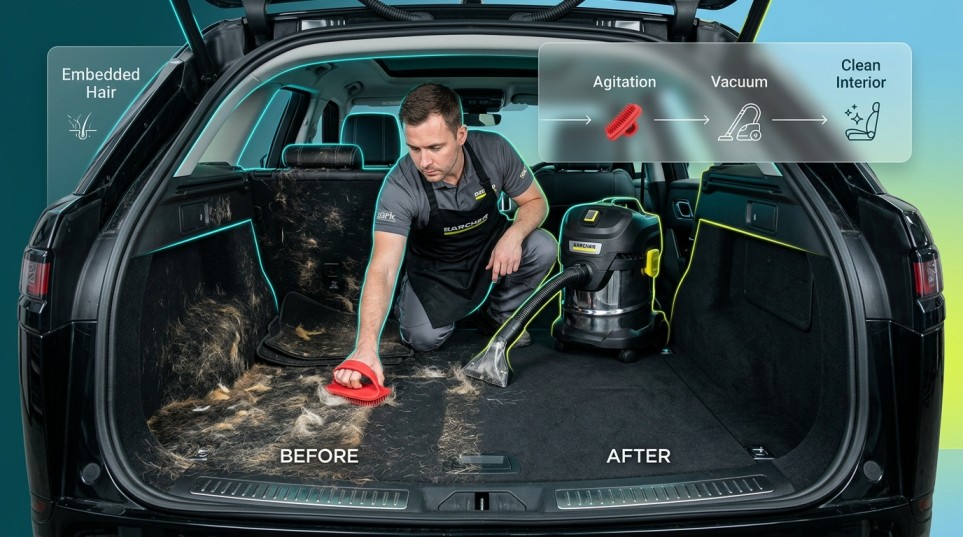
Pet hair removal detailing guide is a hands-on interior service that pulls dog and cat hair out of carpet and upholstery fibres rather than lifting it off the surface. Detailers use rubber tools, brushes, compressed air, and professional vacuums to release hair as a household vacuum slides over. How much comes out depends on the fabric, the volume of hair, and how deeply it has worked into the weave.
Key Takeaways
- Pet hair removal is a separate technique, not a longer vacuum. At Steam Clean Auto Detailing, it is listed as a one-hour add-on at $35.
- Fabric decides the difficulty. Looped carpet and cloth seats grip hair hardest. Leather and vinyl release it in minutes.
- Expect a large, visible reduction rather than a perfect result. Strands can stay in stitching, seams, and delicate materials.
- Hair and odour are different problems. Removing hair does not remove smell. Ozone odour treatment is a separate $50 add-on.
- Vehicle size drives the price. Full interior detailing starts at $179 for a sedan and rises with cabin size.
You vacuum the back seat; it looks clean, then the sun hits the carpet at an angle, and the hair is still standing in the fibres. That is not a vacuum failure; it is what pet hair does inside a car. This guide covers what the service does, what it realistically achieves, what it costs in Calgary, and when a simple add-on is enough versus when the interior needs a full clean.
What Is a Pet Hair Removal Detailing Guide?
Pet hair removal detailing is a focused interior service targeting hair, dander, and the debris that travels with a pet. It covers carpets, floor mats, cloth seats, cargo areas, and the tight gaps where hair collects, and it is usually booked as an add-on to interior detailing.
How Professional Pet Hair Removal Differs From Regular Vacuuming
A vacuum removes what sits loose on top. Pet hair does not sit on top. It works down into the weave and anchors there, so suction alone passes over it. Professional removal adds a step before the vacuum: dedicated rubber tools and brushes that physically lift hair out of the fibres so it can be collected.
The rest of the difference is reach and time. Narrow tools and compressed air clear seat rails, seams, and vents that a home nozzle cannot enter, and the work is done panel by panel rather than in one sweep across the floor.
Why Is Pet Hair So Difficult to Remove From a Car?
A car interior is built from exactly the materials hair clings to best: dense looped carpet, tightly woven seat fabric, and a cabin full of seams and rails that trap anything small.
How Pet Hair Becomes Embedded in Carpet and Upholstery Fibres
Dog and cat hair is thin, tapered, and slightly barbed. Feet, bags, sliding pets, and the vibration of driving push it below the surface of the pile, and once the tip is under the fibres, they hold it in place. Undercoat hair causes the most trouble because it is shorter and finer than the guard hairs you can see, so it drops between fibres instead of resting on them. A vehicle can look reasonably clean and still hold a lot of it.
How Static and Friction Make Pet Hair Hard to Remove
Static is the second half of the problem, and Calgary’s dry air makes it worse through winter. Charged synthetic fibres hold hair against the surface, so a passing nozzle pushes it around instead of pulling it up.
Friction is the answer. Dragging a rubber or silicone tool across fabric lifts hair out of the weave and gathers it into clumps a vacuum can actually collect. A light mist of water reduces static on carpet, though saturation is avoided because damp carpet takes far longer to dry.
Where Pet Hair Hides Inside a Vehicle
Owners find the hair on seats and floors. Detailers spend just as long on the places you cannot see, because that hidden hair is what reappears a week later.
- Seat seams, stitching lines, and the gap between the seat back and base.
- Seat rails and the floor beneath the seats, including plastic tracks and wiring covers.
- Cargo areas, trunk liners, and spare tire wells in SUVs, wagons, and hatchbacks.
- Seat belt webbing, buckle recesses, door pockets, and sills.
- Air vents, where circulating air deposits fine hair and dander.
Who Needs Professional Pet Hair Removal Detailing?
Not every pet owner needs this service. The dividing line is whether the hair is still on the surface or already in the fibres. If you vacuum regularly and stay ahead of shedding, your own routine may be enough. Three situations usually push a vehicle past that point.
Cars With Heavy Dog or Cat Hair Buildup
The tell is simple: you vacuum, the surface looks better, and running your hand across the carpet still brings hair up. Cat hair spreads further than most dog hair, reaching the headliner, dash, and vents, so a cat owner in shedding season can need as much work as a large dog owner.
Vehicles Used Frequently to Transport Pets
If your vehicle handles the off-leash park, the groomer, and the vet, hair accumulates faster than a weekly vacuum keeps up with, and wet dogs press it into fabric where it dries. These vehicles do best with a professional reset once or twice a year and your own maintenance in between.
Cars Being Prepared for Sale or Trade-In
Visible pet hair is one of the first things a buyer notices, and it shapes their impression of how the whole vehicle was treated. A clean interior presents better and removes an easy negotiating point. Detailing improves presentation, but no cleaning service can promise a specific increase in what your vehicle sells for.
How Professional Detailers Remove Pet Hair From Cars
The process is a sequence, and the order matters. Hidden areas are cleared before open surfaces so displaced hair lands where it can still be collected.
Inspecting the Vehicle and Assessing Hair Severity
The job starts with a look at the real condition: which surfaces hold hair, how deep it sits, what materials are in the cabin, and whether stains, moisture, or odour need separate attention. Severity sets both the time booked and the realistic result, which is why an assessment beats a quote given from a phone description.
Loosening Embedded Hair With Rubber Tools and Brushes
This is the core of the service. Rubber and silicone tools and stiff brushes are worked across carpet and fabric in short directional strokes until hair lifts into visible clumps. Pressure is matched to the surface: carpet and durable cloth take firm work, thinner fabric and perforated upholstery get lighter agitation.
Using Compressed Air and Crevice Tools
Compressed air moves hair out of seat rails, tight seams, vent louvres, and console gaps, directed so the hair blows out onto open surfaces. Narrow crevice tools follow with suction. Around screens, switchgear, and connectors, the pressure stays moderate, since forcing debris into a control creates a bigger problem than the hair did.
Vacuuming and Extracting Loosened Pet Hair
Professional vacuuming follows the agitation, working top down and back to front. Expect several passes over the same panel. The first takes the bulk, the second takes what the first pushed around, and a third often still finds hair in the same square foot of carpet. That repetition is a large part of what you are paying for.
Cleaning Carpets, Upholstery, and Floor Mats
Floor mats come out of the vehicle and are treated separately, which is far more effective than working around them. Rubber mats are washed, carpeted mats are agitated and vacuumed, and shampooing or hot water extraction is added when they are also soiled. Removing hair does not remove stains or salt residue, so an interior that has both needs cleaning as well as hair removal.
Final Inspection and Remaining Hair Removal
The last step is a careful look under strong light from several angles, because pet hair is hard to see straight on. Remaining strands are lifted by hand, with tape, or with another light pass of a rubber tool. This is also where a detailer should tell you honestly whether a surface has reached its practical limit.
What Surfaces Can Pet Hair Removal Detailing Treat?
Almost every interior surface can be treated, but the difficulty and the achievable result change with the material.
Carpet and Floor Mats
Carpet is the hardest surface and holds the most hair. Looped automotive carpet is the worst case, since the loops physically trap strands and usually need several passes before releasing them. Carpeted mats are the easiest win in the vehicle because they come out and can be worked from both sides.
Cloth Seats and Upholstery
Cloth seats are moderately difficult, especially the bolsters and the base where a pet sits and turns. Hair usually comes out in stages with lighter pressure than carpet. Perforated cloth and mesh inserts need extra care, because hair pushes into the holes and forcing it deeper is easy.
Leather and Vinyl Surfaces
Leather and vinyl are the good news. Hair sits on top rather than embedding, so it wipes and vacuums away quickly, and the real work moves to edges, seams, and the perforations in ventilated seats. Match the product to the material: many modern seats are coated or synthetic leather, so automotive leather-safe products are used, and at home your owner’s manual beats a household cleaner.
Seat Seams, Rails, Cargo Areas, and Crevices
These areas take the longest and are the main reason a thorough job costs more than a quick vacuum. Cargo areas deserve specific attention if that is where your dog rides, since hair gets under the liner, into the seat-fold mechanism, around tie-down anchors, and into the spare tire well.
Headliners and Other Delicate Surfaces
Headliners are the one area where less is more. The fabric is bonded to a backing board with adhesive, and heavy agitation, saturation, or too much heat can loosen that bond. Light hair is removed with gentle suction and a soft brush, and the same caution applies to pillar trim, visors, and suede-like inserts, where manufacturer care guidance comes first.
Can Pet Hair Removal Be Combined With a Full Interior Detail?
Yes, and it is the more common booking. The add-on exists so it can attach to an interior detail, which is efficient because the mats are already out and the detailer is already working surface by surface. Which service you need comes down to what else is wrong with the interior.
When Pet Hair Removal Alone Is Enough
Book hair removal on its own when hair is the only issue: the interior is otherwise tidy, the carpets are not stained, and there is no smell. This suits owners who keep up with their interior and want a periodic reset before shedding season gets ahead of them.
When Deep Extraction and Stain Treatment Is Needed
Choose a full interior detail when hair is one of several problems, such as muddy paw prints, winter salt residue, or dried spills. Our interior detailing service covers vacuuming, steam cleaning of hard surfaces, upholstery cleaning, carpet shampooing with hot water extraction, vents and crevices, glass, and door and trunk jambs. Extraction leaves carpet damp, so plan for drying time, particularly in cold weather.
When Pet Odor Treatment Is Also Required
Hair removal and odour removal are separate jobs. Pet smell comes from dander, oils, saliva, and moisture absorbed into carpet padding and seat foam, so taking the hair out does not take the smell out. Odour work starts with cleaning the source, because a treatment applied over a soiled interior fades quickly.
Where a smell persists after a proper clean, we offer ozone odour removal as a separate add-on, listed at one hour and $50 on our detailing add-ons page. Ozone is not safe to breathe, so treatment is carried out with the vehicle unoccupied and the cabin ventilated before it is returned. A smell tied to unresolved moisture or contamination under the carpet needs that source dealt with first.
How Much Does Pet Hair Removal Detailing Cost in Calgary?
Pricing follows two things: how much cabin there is to cover, and how much work the hair takes. These are our listed prices at the time of writing and can change, so confirm when you book.
Typical Pet Hair Removal Add-On Prices
Our pet hair removal add-on is listed at $35 for about one hour. It uses tools that pull hair from the fibres and is paired with vacuuming and fabric treatment rather than a surface tidy-up.
Full Interior Detailing Packages With Pet Hair Removal
For most pet owners, the interior detail is the main service and hair removal is the add-on. Add-ons are priced individually, so you only pay for what your vehicle needs.
| Service | Listed time | Listed price |
|---|---|---|
| Pet hair removal (add-on) | 1 hr | $35 |
| Ozone odour removal (add-on) | 1 hr | $50 |
| Sedan full interior | 2 hr 15 min | $179 |
| SUV 2-row full interior | 2 hr 30 min | $199 |
| Truck full interior | 2 hr 30 min | $209 |
| SUV 3-row full interior | 3 hr | $219 |
| Minivan full interior | 3 hr | $239 |
| Construction truck full interior | 3 hr 30 min | $239 |
| Cargo van full interior | 2 hr 12 min | $249 |
How Vehicle Size and Hair Severity Affect Pricing
Size is the predictable variable. A three-row SUV has more carpet, more seats, more seams, and a cargo area a sedan does not have, which is why the listed prices step up with cabin size. Severity is the variable only an inspection settles, since two identical minivans can need very different amounts of labour.
When Heavy Pet Hair Buildup May Cost More
Extra cost reflects extra time, not a surcharge for owning a pet. The two situations that add the most are hair pressed into carpet over a long period, and hair sitting on top of soiling that has to be cleaned as well. If either applies, mention it when booking so the right amount of time is set aside.
How Long Does Pet Hair Removal Detailing Take?
Typical Time for Mild, Moderate, and Heavy Pet Hair Buildup
Our pet hair removal add-on is scheduled for about one hour, and a full interior detail runs from roughly two and a quarter hours for a sedan to three and a half hours for a construction truck.
- Mild: recent surface hair on seats and mats. The one-hour add-on comfortably covers it, especially with leather or vinyl seats.
- Moderate: hair worked into carpet and cloth across the cabin. Expect the full add-on hour, with better results alongside an interior detail.
- Heavy: long-term buildup, often in a larger vehicle with a cargo area. This needs more time than a standard add-on allows.
Why Deeply Embedded Hair Takes Longer to Remove
There is no tool that clears a full carpet in one pass. Every square foot has to be agitated, vacuumed, then checked again, and seams, rails, and cargo mechanisms are worked by hand with picks, brushes, air, and narrow suction. That slow work is usually what separates a thorough result from a quick one.
Can Professional Detailers Remove All Pet Hair?
Professional detailing removes a very large share of the pet hair in a vehicle, and the difference is usually dramatic. Removing every strand from every surface is not something any detailer can promise, and you should be cautious of one who does.
What Results Can You Realistically Expect?
On a vehicle with moderate buildup, expect visible surfaces to look and feel clean, carpets and mats to stop producing hair when you run a hand over them, and hair to largely stop transferring onto your clothes. A few strands released from a deep seam by vibration can still appear days later, which is normal rather than a return to the original condition.
When Severe Buildup Requires Multiple Removal Passes
Interiors that have gone years without a deep clean often need two sessions: the first removes the bulk, the second reaches what was underneath. A detailer should tell you this at the assessment rather than afterwards, since planning two appointments produces a better outcome than expecting one hour to solve years of shedding.
Why Some Hair May Remain in Stitching or Delicate Materials
Some hair stays because removing it would risk the material. Stitching channels, perforations, and panel joins hold strands no tool can reach without pressure that could damage trim, and delicate surfaces are cleaned gently by design. Leaving a strand in a seam is the right call when the alternative is a fray, a mark, or a lifted headliner.
What Are the Benefits of Professional Pet Hair Removal Detailing?
Removes Embedded Hair That Normal Vacuuming Misses
This is the main benefit, and it also resets the interior so your own weekly cleaning becomes effective again. The difference shows most on carpet and cloth seats.
Helps Remove Pet Dander and Trapped Debris
Hair rarely travels alone. Dander, dust, dried mud, grass, gravel, and crumbs collect in the same gaps, and thorough agitation and vacuuming take out that mixture rather than just the visible strands.
Restores the Appearance of the Vehicle Interior
Carpet looks and feels different once hair is out of the pile, and seats lose that dull, matted layer. If you are preparing for a sale or simply want the cabin to feel cared for, this is the visible payoff.
Improves Cabin Air Quality for Allergy Sufferers
Removing hair, dander, and dust leaves less loose material to be stirred up by feet and the ventilation fan, and cleaning vents helps for the same reason. Detailing is a cleaning service, not an allergy treatment, so it cannot remove all allergens or promise symptom relief. If allergies are the main concern, ask your mechanic about your cabin air filter as well.
DIY vs. Professional Pet Hair Removal
DIY methods work within limits. Home cleaning handles fresh hair well and struggles once hair is embedded, which is exactly the problem professional service is built for.
| Factor | DIY at home | Professional service |
|---|---|---|
| Best on | Fresh, surface-level hair on seats and mats | Hair embedded in carpet, cloth, seams, and rails |
| Typical tools | Household vacuum, rubber glove, tape, pet hair brush | Agitation tools, professional vacuums, compressed air, crevice tools |
| Time you spend | 20 to 60 minutes, repeated often | One appointment, roughly 1 to 3.5 hours |
| Main limitation | Suction, reach, and static holding hair down | Cost and scheduling the vehicle in |
| Good fit when | You clean regularly and stay ahead of shedding | Hair is embedded, or the vehicle is being sold |
When DIY Pet Hair Removal May Be Enough
Timing beats effort. A rubber glove or pet hair brush dragged across seats gathers fresh hair into liftable clumps, and pulling the mats out to beat and vacuum them handles most of the floor. Five minutes after a park trip saves an hour later.
Limitations of DIY Methods on Embedded Hair
Home vacuums run out of capability once hair is below the surface, and there is no practical way to clear seat rails or the channel between seat back and base. A few cautions: do not soak carpet trying to beat static, keep aggressive brushing off headliners and perforated seats, and check your owner’s manual before using any product on interior surfaces.
When Professional Equipment Is Worth It
Professional service earns its cost when you have already tried, and the hair is still there, when the vehicle is large enough that DIY becomes an afternoon of work, when hair is one of several interior problems, or when you are preparing the vehicle for sale.
How to Prepare Your Vehicle for Pet Hair Removal Detailing
Ten minutes of preparation buys you a better result, because every minute spent moving your belongings is a minute not spent on the carpet.
Remove Personal Items and Loose Debris
Take out car seats if you can, along with cargo organizers, blankets, bags, and anything in the trunk, and clear the console, glovebox, and door pockets of valuables. Wash pet blankets and beds the same day, since putting a hair-covered blanket back in undoes part of the work immediately.
Identify Areas With Heavy Pet Hair Buildup
Point out where your pet actually rides. The back seat, the cargo area, or a specific footwell each get different treatment, and knowing the hot spots lets us plan the time and prioritise the surfaces you care about most.
Tell the Detailer About Odors, Stains, and Other Interior Issues
Mention any smell, spill, or accident before work begins, since odour is a separate service and a plan is only useful when the source is known. Flag anything unusual too, such as damp carpet, a leak, or visible mould-like growth, because those need a different conversation from routine cleaning.
Mobile vs. Shop-Based Pet Hair Removal Detailing in Calgary
We offer both, and neither is universally better. Season, working conditions, and how much cleaning the interior needs decide it.
Benefits of Mobile Pet Hair Removal
Mobile service is about convenience. We come to your home or workplace with our own equipment and water supply, so you are not building your day around a drop-off. You need a parking spot with room to work around the vehicle, and it is worth confirming power access when you book.
Benefits of Taking Your Vehicle to a Calgary Detailing Shop
Calgary weather is the main reason to choose the shop. From November through March, mobile work needs a heated garage, so the alternatives are drop-off or an insured pickup. Indoor space also matters when shampooing or extraction is involved, because damp carpet dries slowly in the cold, and consistent lighting genuinely helps with spotting the last strands of hair.
Which Option Is Better for Your Vehicle?
Choose mobile in the warmer months when hair removal is the main job, and you have somewhere suitable to park. Choose the shop in winter, when the interior also needs shampooing or extraction, or when heavy buildup calls for a longer, controlled session.
How to Choose a Pet Hair Removal Detailer in Calgary
Pet hair is a specific skill, and not every detailer treats it as one. Five things are worth checking before you book anywhere.
Experience With Embedded Dog and Cat Hair
Ask how they handle hair that is embedded rather than on the surface. A useful answer describes agitation before vacuuming and covers seams, rails, and cargo areas. An answer that stops at powerful vacuums tells you what will be left behind.
Professional Tools and Removal Techniques
Look for rubber or silicone agitation tools, compressed air, and narrow crevice tools alongside professional vacuums, and ask how they adjust for delicate materials such as headliners and perforated seats.
Transparent Pricing Based on Vehicle Size and Hair Severity
Pricing should be tied to vehicle size, service scope, and condition. Published prices help you compare, and a detailer should explain what could change the final figure. Be wary of a flat quote given with no information about the vehicle.
Before-and-After Results and Customer Reviews
Ask to see interior work rather than polished exterior shots, since carpet and seat photos say far more about pet hair capability. Reviews that mention your specific problem are worth more than a general rating, though every vehicle starts in a different condition.
Calgary Service Areas and Mobile Availability
Confirm your address is inside the service area, ask what mobile service is needed at your location, and check winter arrangements, since mobile availability here changes with the season. It is also fair to ask whether a business is insured and registered before handing over your keys.
How to Manage and Prevent Pet Hair Between Professional Details
Prevention is the part you control. Hair that never reaches the carpet never has to be pulled out of it.
Use Seat Covers and Protective Blankets
A washable seat cover, hammock, or cargo liner is the single most effective step, because you wash the cover instead of cleaning the interior. Choose one you will actually fit each time.
Groom Pets Before Car Trips
Brushing before a ride removes loose hair while it is still outside the vehicle. During shedding season, and for double-coated breeds in spring and fall, this makes a visible difference.
Vacuum Pet Hair Before It Becomes Embedded
A short vacuum every week or two beats a long session once a season, and it keeps the interior in the range where DIY methods still work.
Remove Fresh Hair From Seats and Carpets Regularly
Keep a rubber glove, pet hair brush, or lint roller in the door pocket and use it after trips. Pull the mats out and shake them regularly too, since mats collect the most and are the easiest thing to clean.
How Often to Schedule Professional Pet Hair Removal
Let the condition of the interior decide, not the calendar. Run your hand across the carpet after your own vacuum: if hair still lifts out of the fibres, it is embedded, and it is time to book. Many pet owners land on once or twice a year, timed around spring and fall shedding, while a heavily used vehicle with a big shedding dog may need it more often.
Conclusion
Pet hair is a mechanical problem and needs a mechanical solution. Once it works into carpet and cloth, suction alone stops being enough, and the fix is agitation, patient vacuuming, seam and rail work, and a careful final check.
Three questions cover most of the decision. Is hair the only problem, or does the interior need cleaning too? Is there a smell, which is a separate service? And is the buildup light enough for a one-hour add-on, or heavy enough for a full interior detail and possibly a second pass?
If you want a hand deciding, tell us what you are dealing with, and we will recommend the service that fits. **Call Steam Clean Auto Detailing at 587-284-9087 to book pet hair removal or an interior detail,** or ask about mobile service if you would rather we come to you. We are an insured and registered detailing company at 428 Livingston View NE, Calgary, serving Calgary, Airdrie, Cochrane, Chestermere, Strathmore, Okotoks, High River, Bragg Creek, and Springbank.